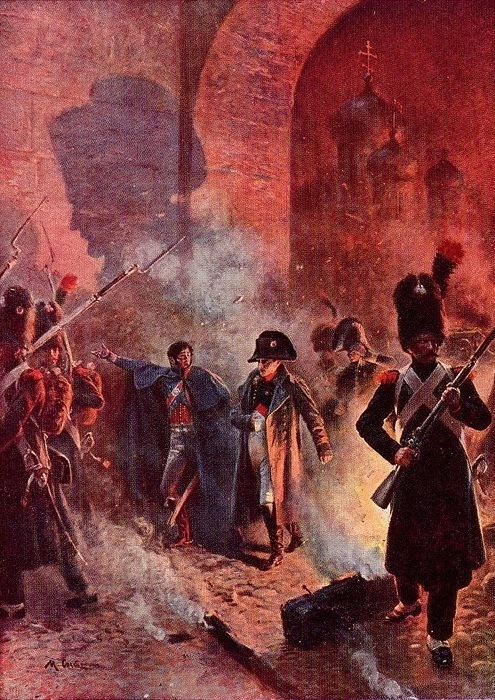
Napoleon’s army entered Moscow after the bloody Battle of Borodino and weeks of pursuit. The emperor expected the city’s occupation to force Tsar Alexander I to negotiate.
Instead, the French found a capital emptied of most of its residents and officials. There was no delegation and no offer of peace. Within hours, fires appeared across the city.
A prize that could not feed an army
Much of Moscow was built of wood. Wind carried the flames through streets and warehouses, while firefighting equipment had been removed or was unavailable. The cause remains contested in its details, but the destruction was immense.
Waiting for an answer
Napoleon stayed for weeks, hoping political pressure would produce negotiations. Alexander refused. Meanwhile, the army’s supply position worsened and winter approached.
The road back
The French began leaving Moscow in October. Retreat routes offered too little food, Russian forces applied constant pressure, and freezing weather multiplied the losses. The huge army that had crossed into Russia was reduced to a fraction of its strength.
Taking a city had not ended the war. Moscow revealed the difference between occupying a symbol and achieving the political result a campaign was meant to deliver.
Sources
- Fondation Napoléon, The Russian Campaign: From the Niemen to Moscow
- Fondation Napoléon, The Russian Campaign: The Retreat
- Library of Congress, Map of the Russian Campaign 1812
- Wikimedia Commons, Napoleon leaves the Kremlin image record
Last reviewed September 14, 2026. Report a correction.